Friday, 9 May 2008

Life Less Ordinary For A Rare Breed of Thespian


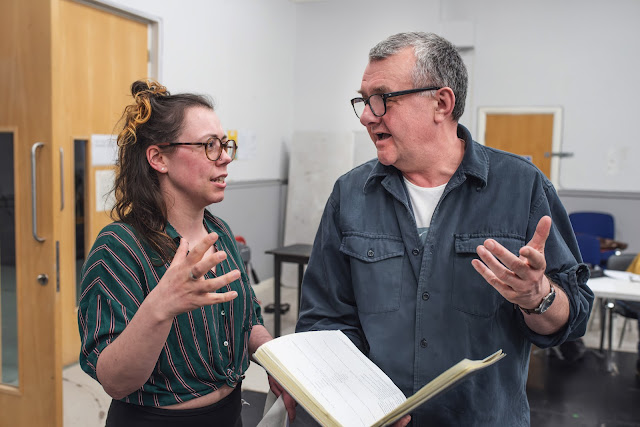
Herald critic Neil Cooper talked to Sandy Grierson from Little Otik last week about his work as Artistic Associate with Vanishing Point Theatre Company. Read the full article here on the Herald website. Sandy (pictured above left) plays the father to Otik in the play which opens here at the Citz on 21st May.

"I loved it, totally loved it"

In todays' edition of The Herald, there is a follow-up feature article about Debbie Findlay who was one of the leading characters in They Shoot Horses, Don't They?

You can read it here. I'm not sure how long this link stays live, so if you get the chance read it today!! Well done Debbie!

Hx

Little Otik - a baby is born in rehearsal

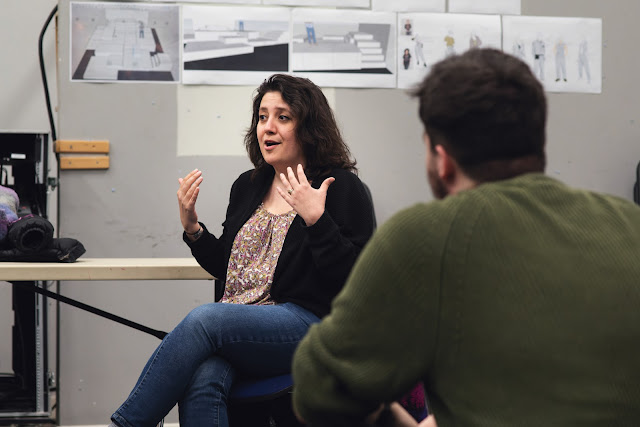
Some strange sounds have been emanating from our main rehearsal room this week as Vanishing Point Theatre Company bring to life the surreal story of Little Otik. Now the two week fit-up has begun on stage and it is already taking shape with dark gauzes, twisted branches, bizarre puppets and ten tonnes of dirt all making it look very interesting! It is definitely becoming one of our most highly anticipated shows of the season. Here's a snapshot of some moments in the rehearsal room...


The show opens in just 2 weeks time - 21st May.
You can book your tickets now by calling the box office on 0141 429 0022 or book online at www.citz.co.uk

This is one you will want to look back on and say 'I was there'.
Ax

Tuesday, 6 May 2008

Horses Reach Finishing Post!

Three weeks have past since the final performance of They Shoot Horses, Don’t They? and I just wanted to post a reflection on the process. There is so much to say but I’ll start with…this project was the most challenging to date and indeed the one I’m most proud of… I’m sure I’ve said that before!!


The five weeks of rehearsal and performance were an incredible journey as I’m sure many of the 40 strong cast would testify. I remember the first week ending on such a high as if nothing could go wrong. Certainly, most of the time, there was a wonderful feeling of support and creativity in the rehearsal room. We danced with Linda and Elly, we ran races in slow motion, we took part in a workshop led by visitors from Sweden, we changed dance partners many times, we laughed a lot, we struggled, became tired, got angry with each other and applauded when Sally sang with the band and George got his trumpet out!


I was impressed by the commitment of so many members of the company, there were a few who I thought would never see it through to the performance but I was happy to be proved wrong. Community Company and YOUNG Co. regulars were strong but the newcomers from Turning Point, blew me away and I hope they are as proud of what they achieved as Elly and I are…we miss them but hope they take whatever they got from the experience and move on positively. Thank you to all who contributed. I know none of us will ever forget the rehearsals, our costume, the fabulous set, the lighting, the music, our words and most of all the feeling of what we achieved in those five weeks…Watch this space for the next Community Company event…

Neil Packham
Community Drama Director
all photos by Tim Morozzo

Monday, 21 April 2008

Yellow Moon

If you are an avid reader of the TAG blog (for all our children and young people's news), you will have heard the latest - David Greig has just received the Brian Way Award 2008 for Yellow Moon. This award is given to playwrights who write for young people.

This news arrives just as the Yellow Moon cast land in New York for the Brits off Broadway festival. The 2008 tour kicks off this Wednesday at 59E59 Theaters in Manhattan. The show is there for a month, before returning to the UK for a tour. If you don't know what it's about, we have a new 1 minute trailer that explains all...

Hx

Thursday, 17 April 2008

Little Otik - new trailer released

In our rehearsal rooms a dark story is developing...about a baby made from wood! Intrigued? It's the fabulous story of Little Otik, based on the cult film by Jan Svankmajer. Adapted and Directed by Matthew Lenton, this is the latest offering from the ever creative and outstandingly imaginative Vanishing Point theatre company in a new collboration with National Theatre of Scotland and ourselves here at the Citz.

Just click on the video below to watch a trailer for the show and we'll be bringing you more behind-the-scenes footage and interviews as the show is lovingly brought to life.

video

Thursday, 10 April 2008

Opening Night Success

Last night saw a fantastic start to They Shoot Horses, Don't They? at the Citizens' Theatre. A big crowd came to enjoy a brilliant performance. Well done to all involved - a special mention must go to all those who had never before acted on stage. In fact even some of the experienced members of the Community Company had never before been on the Citz main stage...I would imagine a rather daunting prospect.


I have to say that there were fantastic performances all round. What a huge achievement. The show is on until Saturday night, so there are still 4 chances to see it. Call 0141 429 0022 to book your ticket!...or book online here.

Photos by Tim Morozzo.
Hx

Monday, 31 March 2008

They Shoot Horses, Don't They?

If you think that endurance competitions, of the type where the last person still holding onto the car wins it, are a product of this age of reality TV then think again. Back in 1930's America they were being pioneered in the form of dance marathons, where competitors waltzed or fox-trotted their way to a big money prize - but if only if they were the last couple standing after many arduous days (sometimes months) dancing without breaks.

We recently posted images of the set that is being constructed for THEY SHOOT HORSES, DON'T THEY?, our next large-scale community project, and now we can show you some of the cast in rehearsal.

With a cast of nearly 40, they are quite an impressive sight (as you can see!) and are spilling out of the main rehearsal room, which is the biggest one, and into all the smaller rehearsal rooms too.


Of this vast cast, only one is a professional actor and many have never done anything like this before so everyone involved is having a great time getting to grips with new skills!


I can't wait to see them all in their 1930's costume! Cx

Wednesday, 12 March 2008

Easter Academy - drama for 6-12 year olds

Click here for more info, or phone 0141 429 0022 to book a place!

Hx

Thursday, 6 March 2008

Six Characters: The Author

David Harrower, who adapted Luigi Pirandello's Six Characters in Search of an Author, gives answers to the questions that needed to be asked….

Six Characters caused riots in the theatre when it was first performed in Rome in 1921. Why do you think it was so shocking to some of the audience then, and is it still as shocking today?

It's difficult to pinpoint exactly why the audience rioted at the play's first performance. Some have claimed simply that nothing like it had been seen before on the Italian stage – but this isn't strictly true. Pirandello was writing at a time when the Futurist movement and Theatre of the Grotesque were imprinting themselves culturally on Italian society, and he himself had written earlier plays that questioned, albeit in a less complex way than Six Characters, what dramatic reality was and what truths and 'messages' an audience should expect from it.

It could perhaps have been the subject matter – the story of the Characters touches on poverty, prostitution, children born outside of marriage and sexual interest in young girls – plus a tragic, horrible ending (or is it?) – and it may well have been that the profusion of so many societal themes in one play sparked the audience off.

But on top of this there's also the fact that because of the very nature of the play it's only partly concerned with the story it's telling – it lurches forward in fits and starts, it refers back to itself and argues with itself and questions itself. And all this can lead to the viewer asking: whose story am I watching here? Is it Pirandello talking, or his characters? To what extent do I get emotionally involved? And (it happens, I promise) what kind of cruel metaphysical trick is being played on me by this bloody long-dead Sicilian writer?

Anyhow, back to the question of why the riot..? I'm not sure I know the answer to that question.


The play features a group of 'characters' discarded by their creator yet desperate to 'exist' nonetheless. Have you ever discarded a character during your own writing, and how do you think he or she would react to being rejected by you?

I've lost count of the number of characters I've 'discarded' or 'rejected', though of course I'd prefer to say I left them behind or allowed them to fade away, that sounds more poetic. 'Discarded' seems so harsh though, on reflection, it's the reality. Some characters just never become what they promise to be at the beginning – they never assume an independent voice, they can be tiresomely humourless and demanding. All it takes is a pen to score through them on the page or the Delete key on the keyboard. Click. Out of sight, out of mind.

It depends also on how a writer goes about creating their characters, how they're brought into being. The characters can come first and a story be found around and through them or – and this is the way I've always worked – I'll have the arc of a story and then populate it with a certain number of characters - indistinct, nameless characters but necessary at that time to carry the story for me. And as I go about refining it, the characters will reveal themselves – they'll become distinct and need, indeed demand, naming. And as I do this and gradually find out what the hell it is I'm trying to get across in the play – and which characters I absolutely need to do this. Then there is generally a silent but deadly cull.

I don't think I've ever axed a character to whom I'd given a name – though I probably have and forgotten about it – but what does happen most times is that some aspects of the killed-off characters are usually resurrected in the characters left standing.

Finally, all I'd say to those characters who served and fell at my desk, in my notebooks and upon my computer screen, your sacrifice was necessary for the greater good of the story. Sorry.


A play about theatre and theatricality might be considered slightly insular or closed. What is it about Six Characters that makes it relevant to a wider audience beyond the world of theatre?

I'm not entirely sure how to answer this. I hesitate when it comes to questions of relevance and what an audience should 'get' from a play. In one way, this question is exactly what Pirandello brings to our attention in Six Characters – should something be 'got' from a work of art? Does the necessary artifice of theatre (people inhabiting characters and attempting to make them real to an audience) ultimately rob us of deeper meaning or does what Pirandello would call `play-acting’ actually help us understand better? There are questions here about empathy, compassion, emotion, an audience's relationship to a story, a theatre company, a theatre building, the public funding of art-forms, the list goes on.

What I 'get' from Six Characters will be different from most of the audience because I've read the play several times and have worked on this version twice, first for the Young Vic and now, a revising of that for Mark Thomson's production (and I'll be the first to throw my hand up and say my text for the Young Vic had some glaring mistakes in it). So even I didn't get the play right the first time. It's tough and knotty and unrepentant and infuriating at times. I loved it once, then went through a period of indifference towards it, thinking wrongly it led more from the intellect than from emotion. But then, another re-read, hearing the Scottish actors get to grips with it, seeing light shine on to it from another vantage point and I'm back to loving it again. Is that not how any relationship with a work of art should be? A constant tussle?


Having adapted the likes of Chekhov, Buchner, Schiller and of course Pirandello, how would you feel if one of your own plays were to be adapted by another playwright?

I'd hope that I, like the great Luigi Pirandello himself, were dead.